Forum : Oo! Let's Make a Game! Episode 5: Sticky Situations!

Current User: Guest Login Register
Please consider registering

Search 
Search Forums:


Oo! Let’s Make a Game! Episode 5: Sticky Situations!
Read original blog post

Add a New Topic Reply to Post
Post

Robert Bohl – Admin

9:18 am – September 23, 2009

posts 55

01:54:51 long & 110.3 MB big

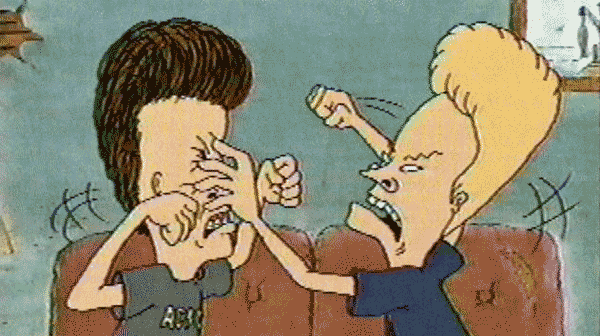
In this episode, Robert Bohl (designer of Misspent Youth) and Joshua A. C. Newman (designer of shock: social science fiction), discuss how to pre-bake-in a situation for the game they’re developing. Many hearts were broken, unforgivable things were said, will they still be friends at the end of this arduously long show? Listen in to find out.

Joshua’s homework (Rob didn’t do his).

- We start of being enthusiastic about Idiocracy
- Rob skipped homework, Joshua didn’t
- Discussing input from Vincent Baker, Simon C., and Doc Holaday
- Charles Stross’s Accelerando
- Futurama
- Transhumanauts!
- John Cassaday and Warren Ellis’s Planetary
- My friend Blake, who had an interesting idea for a game
- The movies Cube and Saw
- Montsegur 1244 and carry: a game about war
- Ganakagok
- 100 Bullets
- Exquisite corpse
- Wildly various spider genetalia
- Twenty Bucks
- Psi Run (or, at least, its forum)
- Dogs in the Vineyard
- Mouse Guard RPG
- Do not look Vincent Baker in the eye
- Our homework: Vomit forth creativity on this project
- Listener homework: Give us some scenarios

Rob’s during-the-show notes

You can subscribe to the show by plugging the RSS feed URL into your preferred podcatcher. You can also use the one-click iTunes button thingie:

The intro music is “Gotta Whizz” by Boris the Sprinkler, from the album Mega Anal. The outgoing music is Overlap by Ani DiFranco from the album Out of Range


Read original blog post

My endeavors:
Misspent Youth: Teenage rebellion in a fucked-up future.
The Independent Insurgency

lumpley – Member

1:10 pm – September 23, 2009

posts 40

As a person who gives a shit, this show makes me insano banano. INSANO BANANO!

Maybe I'll say something substantive when I've recovered some of my bananity.

joshua – Admin

1:17 pm – September 23, 2009

posts 159

You too?

I'd like to know what makes you insano banano about it. I know what's insaning my bananing already.

Joshua A.C. Newman

joshua – Admin

1:19 pm – September 23, 2009

posts 159

… um, and that's that the collaborative, weekly format is keeping us from focusing well. Now that we've done a two-hour episode, maybe we can produce enough stuff as homework that we'll gain some clarity.

Joshua A.C. Newman

lumpley – Member

7:20 pm – September 23, 2009

posts 40

So you leapfrogged over “create an initial setup” and landed on “create a fully-fleshed initial situation.” How come?

“Some of the protagonists take on fantasy personalities, to fulfill others' fantasies; some of the protagonists investigate, broker, and control those transactions.” You two are wicked resisting this level of description for your game. You've tried to describe your game at every single level except it, but it's the one that unlocks the rest.

That's what insanes my bananes.


Dan Maruschak – Member

Eugene, OR

9:38 pm – September 23, 2009

posts 18

In the show you talked about the perverse situation where more developed countries sometimes lag behind in tech adoption. You mentioned some reasons for it, but I didn't hear you mention one of the reasons I heard from the marketing people back when I worked in the microprocessor industry: When someone starts from zero in a less-developed region, there's a huge ROI for going right to the top-of-the-line tech. It generally only costs a little more than older tech, but gives bigger benefits. In the more developed areas, the new tech is competing with old established tech. The ROI decision there is based on the difference in capabilities (i.e. what can the new tech do over and above the old tech, not what can the new tech do compared to nothing), but the cost of adopting the new tech is similar to the cost if you had just started from scratch — you don't get any kind of advantage for having already adopted the now-obsolete tech. Therefore the ROI of a tech change frequently looks worse for developed areas. That might be something you could work into your tech web stuff.


Renato – Guest

2:55 am – September 24, 2009

I have yet to listen to some 15 minutes of the show, but I wanted to drop in a thought.


Rob: what I percieve is Josha being resistant to (regarding your “benefactor/whatever” idea) is the general idea of an external force or push as opposed to a narrative drive that is born entirely inside the character's network and expanding.

Also, if we want to bring in a bit of theory, having that external actor bears the risk (not automatic, but risky) of having the premise answered/addressed by someone else (or by the gm/whatever), which would work against having that in the hands of the players.


Am I too far off target people?

Josh Crowe – Member

3:45 am – September 24, 2009

posts 7

I should have mentioned this earlier.  I for one am not concerned that you don't know what people do.  


Remember that this game is extremely sparse at this point.  At this point that “aboutness” is not needed, it only needs to be in process.


My thoughts about the conflict here is that you are debating each others half baked ideas.  You need to finish baking the ideas and show each other.  Whatever that means.

Robert Bohl – Admin

8:46 am – September 24, 2009

posts 55

Post edited 12:47 pm – September 24, 2009 by Robert Bohl


lumpley said:

So you leapfrogged over “create an initial setup” and landed on “create a fully-fleshed initial situation.” How come?

“Some of the protagonists take on fantasy personalities, to fulfill others' fantasies; some of the protagonists investigate, broker, and control those transactions.” You two are wicked resisting this level of description for your game. You've tried to describe your game at every single level except it, but it's the one that unlocks the rest.

That's what insanes my bananes.


Vincent,

I would love to — but do not — understand what you mean here.

Joshua: we can switch to biweekly shows, we can change the format to allow us to talk off-mic, do you think this will get us what we're looking for?

Renato: how can it be an external force if it's one of the players doing it, and not always the same player, and most of the resultant action is seen from the point of view of the spotlight protagonist?

Josh: This may be the case but it's natural for us to talk about this sort of thing right now.

My endeavors:
Misspent Youth: Teenage rebellion in a fucked-up future.
The Independent Insurgency

Josh Crowe – Member

9:49 am – September 24, 2009

posts 7

I agree it is natural.  Fighting is the second most natural thing for two people to do. 


lumpley – Member

11:06 am – September 24, 2009

posts 40

Rob:

Well, in Misspent Youth you play idealistic kids who fight against the stomping boot of authority. In Dogs in the Vineyard you play God's Watchdogs, holding the Faith together in the face of sin, hate and murder. In Shadowrun you play violent operatives taking on gangs, corporations, and rival operatives. In Under the Bed you play a child's beloved toys helping the child through a difficult time in her life. What about this game?

When you talk about spotlight episodes, for instance, or a tech web, or oracles, or co-GMs, or finding out what's true about your character – anything procedural whatsoever – you're speculating, plainly and fruitlessly, based only on unstated presumptions about who are the characters and what do they do. You're trying to decide that, like, characters get spotlight episodes, but you don't even know who your characters are or what they do, so you have no way to know whether spotlight episodes are something that they even need.

…And without an answer to who are the characters and what do they do, it's premature to talk about specific characters, specifically situated, too. Take carry for instance. “In carry, you play a squad of American soldiers fighting in Vietnam. Particularly, you play Ramsey Capello, David Steinbeck, Elmo Smith…” Same thing with Montsegur 1244: “in this game you play doomed Cathars forced to decide between life and faith. Particularly, you play Bertrand, Cecille, Esclarmonde…” You're trying to jump to “in this game, you play Michelle, Plaster, Raimondo…” without first narrowing them down from everybody-in-the-world.

Here's the problem.

In this game, you play people at the cutting edge of some new transhumanizing technology.

Right?

LIFELESS. There's nowhere to go with it, no first step to take from there. That's because it's missing that active, conflict-charged verb. Fulfilling others' fantasies, investigating, brokering, controlling, fighting against, holding together, taking on, helping the child through. THAT's what you two need to come up with.

Narrowing down the technology will help.

(If you don't want to come up with it yourselves, but instead leave it to the players at the table, like Shock: and PTA do, that's fine, those games work great. But do notice just how easy it is to come up with examples for Shock: and PTA, and how very difficult it is to come up with equivalent examples for the thing you're working on, and be prepared to tackle that problem.)

Robert Bohl – Admin

1:05 pm – September 24, 2009

posts 55

Good stuff, Vincent.

Ok, so I was trying to get at some of that during the episode. To do it succinctly like you did, above:

  • In X, you play people brought together by a madman who change their bodies to find out what it means to be human.
  • In X, you play someone in a crisis who tries to solve it by changing himself with technology.
  • In the first scenario of X, you play people in a war ravaged refugee camp trying to deal with their problems by changing themselves with technology.

There's surely a common theme there, but none of them is as punchy as the examples you give.

Thanks.

My endeavors:
Misspent Youth: Teenage rebellion in a fucked-up future.
The Independent Insurgency

Robert Bohl – Admin

1:05 pm – September 24, 2009

posts 55

Good stuff, Vincent.

Ok, so I was trying to get at some of that during the episode. To do it succinctly like you did, above:

  • In X, you play people brought together by a madman who change their bodies to find out what it means to be human.
  • In X, you play someone in a crisis who tries to solve it by changing himself with technology.
  • In the first scenario of X, you play people in a war ravaged refugee camp trying to deal with their problems by changing themselves with technology.

There’s surely a common theme there, but none of them is as punchy as the examples you give.

Thanks.

My endeavors:
Misspent Youth: Teenage rebellion in a fucked-up future.
The Independent Insurgency

Robert Bohl – Admin

1:33 pm – September 24, 2009

posts 55

Things I'm thinking of doing in prep for next week's record:

  • Coming up with a list of technologies that are gooey and can be expanded upon.
  • Coming up with interesting transhumanist characters.
  • Coming up with a list of “you play X” sentences.
  • Really thinking about and then writing about what I find interesting about transhumanism.

My endeavors:
Misspent Youth: Teenage rebellion in a fucked-up future.
The Independent Insurgency

lumpley – Member

2:36 pm – September 24, 2009

posts 40

Rob:

> Coming up with a list of “you play X” sentences.

Cool! Mind if I go on a bit?

The problem isn't that yours aren't as punchy, the problem is that yours lack conflicts of interest. (That may be what you mean, but it's really a presence vs a lack, not more vs less.)

Look out for “try,” for instance. “Try” can disguise a useless verb, mask it with an illusion of action. If you add “try” to my examples, you don't add substance – “try to fulfill others' fantasies” isn't stronger than “fulfill others' fantasies,” because “fulfill others' fantasies” is already electric with the possibility (certainty?) of failure. They're “trying to fight in Vietnam”? That's not even a thing. In the same way, see how null “you play someone in a crisis who solves it by changing himself with technology” is?

Also notice that all of mine say what the characters are up against, and yours don't. I know that when I say about Misspent Youth, you're perfectly comfy with me naming the stomping boot of authority. That's, like, the point. But here, you're almost studiously avoiding naming the enemy, opposition, the force or circumstance they'll have to overcome. The closest you get is the war ravaged refugee camp, but then you leave that dangling by switching to “deal with their problems.” How about “you play people surviving in a war ravaged refugee camp by changing themselves with technology”? “Surviving in a war ravaged refugee camp” just kicks the ass of “dealing with their problems,” even if it's a war ravaged refugee camp where they live.

You can try specifying a problem, that'll help. So would specifying a technology. “You play people in a war ravaged refugee camp dealing with starvation by changing themselves with technology” – more interesting. At least now we see what the conflicts can be, what the technology might be, and as designers, what we'll have to create rule systems for. Same with “you play people in a war ravaged refugee camp dealing with their problems by swapping bodies.” Every bit of concreteness contributes concreteness to all. We can imagine the kinds of problems that swapping bodies might solve, instead of just some nebulous floaty kind of just, y'know, problems.

Dollhouse's spec makes everything concrete, though. The verb, the prob, the technology, what they're up against. It even has a couple-three kinds of characters, which of course you might want too. I'd follow its lead.

Robert Bohl – Admin

2:46 pm – September 24, 2009

posts 55

Thanks, Vincent. This is really helpful to me.

So my concern there is creating something way too narrow and specific that people don't have a lot of options for what to play. It's a conflict between “focused generic” and “really specific” that you see in Forge-dervied games. (As you note, Primetime Adventures and shock: are on one end, and something like Montsegur 1244 or The Shab al Hiri Roach are on the other.)

If we want to do a focused generic game (and we should probably talk about whether we do or not) we can probably do so by taking a really specific example and using that as our template.

Hmm.

My endeavors:
Misspent Youth: Teenage rebellion in a fucked-up future.
The Independent Insurgency

lumpley – Member

3:02 pm – September 24, 2009

posts 40

There's also the GURPS-and-kin solution, which is to have one player (the GM) spec the game. “Hey, let's play Transhumanauts. I'm thinking of running a game where the PCs are, like, a legal research team, on the prosecution's side, making sure that even though people can swap bodies, the right person gets convicted for a crime. Wanna play?”

That kind of focused generic game isn't much in evidence here in Forge-land, but it's still perfectly viable.

timfire – New Member

5:23 pm – September 24, 2009

posts 1

I hate to say this Rob, but the “patron” / “agent of change” is a bad idea. I don't think it will lead to the type of play you guys have been talking (through #4).


The reason it's a bad idea is because the agent *IS* intereresting. I *want* to explore and find out more about that guy. And that means I—and other players, I assume—would probably drift play away from identity, and towards consipiracy.

– Timothy Walters Kleinert

doc – Member

1:44 pm – September 26, 2009

posts 15

Post edited 7:32 pm – September 26, 2009 by doc


I haven't read the other posts in this thread because I have only listened to the first half of the show (three times). (The “why” of that is random and unimportant.) Three quick things:

1) I'm hearing more collaboration in this show. I feel like you two are “negotiating” more in this cast than in others. In other words, I think the creative process is a bit more shared in this one. To make an observation, you do often fall into a pattern where J. rejects and R. tries to quickly shift the idea to gain assent. I felt like R. did a lot of proposing and J. did a lot of filtering. That may be your natural creative roles, though. (And maybe my observations will change after listening to the second half.)

2) What I've heard of the situation so far I really like. From the point you bring up 100 bullets and talk about a serial format, I became a lot more interested in the game. I like the idea of an agent that changes and is unpredictable (to some extent) from game to game. I seems fun to me as a player to try and figure this person out (partially by steering the fiction in a way that contributes to his/her/its story so that the eventual outcome must incorporate the inputs).

3) Oh, the fucking currents. Give up those names. Hell, it's YOUR game and YOU can't even remember how to say them. You all struggled repeatedly with them during the cast. Don't you think this says something about how players will be able to remember and deal with them? If you must keep these socio-political distinctions, rephrase or rename them so that they are more meaningful. (This is only my OPINION, obviously.)

doc – Member

3:24 pm – September 26, 2009

posts 15

Post edited 7:34 pm – September 26, 2009 by doc


Regarding “3)”. Sorry. That was reaction and it was probably unfair as criticism. I think you all are perhaps moving toward more meaningful currents though situation and character.

If the audience were voting, which it is not, I would say I like Rob's proposal about a serial game with a new situation and spotlight character each episode. But at the same time I see timfire's point above, that the game could quickly become about the mysterious agent rather than transhumanism. Maybe the 100 Bullets inspired serial game is another RPG entirely and you can create it later. Having said that, the highly specific situations (e.g. refugee camp) leave me cold. It feels like you don't trust the players to come up with something interesting on their own. (And maybe you don't.)

Finally, one more book reference (and no need to read this one). John Scalzi writes a military science fiction (probably more science fantasy really) series that begins with Old Man's War. In it old people's minds are transferred to rockin' new bodies with all sorts of great enhancements. At one point in the story the main character runs into a clone of his deceased wife, who is yet another type of engineered body with a human consciousness in it. They struggle to deal with emotions that really belong to another time, place, and pair of bodies. Unfortunately, this theme is the best part of the books and it only inhabits about 15% of the pages or less.

Reply to Post


Reply to Topic: Oo! Let’s Make a Game! Episode 5: Sticky Situations!

Guest Name (Required):

Guest EMail (Required):

Topic Reply:

Save New Post

Guest URL (required)

Math Required!
What is the sum of:
9 + 1


Search 

About the xenoglyph forum

Most Users Ever Online:

27


Currently Online:

6 Guests

Forum Stats:

Groups: 1

Forums: 5

Topics: 50

Posts: 462

Membership:

There are 95 Members

There have been 10 Guests

There are 2 Admins

There are 0 Moderators

Top Posters:

Simon C – 81

lumpley – 40

Dan Maruschak – 18

doc – 15

Josh Crowe – 7

Suna – 6

Administrators: joshua (159 Posts), Robert Bohl (55 Posts)